


.png)
If you have a dirt road that turns to mud every rainy season, or a maneuvering yard that kicks up dust year-round, you've probably already looked into solutions: asphalt, gravel, cement… all of them expensive, slow, or simply short-lived options.
The ionic soil stabilizer is an alternative that has been proven in Mexico and Latin America for more than two decades. It's not a temporary patch: it acts at the molecular level on the soil particles, permanently changes their polarity, and turns unstable terrain into firm, waterproof surfaces ready for heavy traffic.
Here we explain how it works, which sectors it's used in, and why more and more Mexican companies, from poultry farms to real estate developers, are choosing it over traditional methods.
What is the ionic soil stabilizer?
It's an organic liquid compound that acts at the molecular level on the soil: it breaks down the water film surrounding the clay particles, changes their polarity, and binds them together permanently and irreversibly. The treated soil becomes hydrophobic and can withstand heavy traffic without deforming, with a minimal dosage of 0.05 to 0.065 L/m³ compared to the 2–8% by weight required by lime or cement.

Common mistakes when stabilizing a dirt road
Ionic technology works when it's applied correctly. These are the most common mistakes that keep a project from delivering the expected results:
1. Skipping a prior soil analysis
The ionic stabilizer reacts differently in each type of soil. Applying it without a CBR test and AASHTO classification is like prescribing medication without a diagnosis. The wrong dosage can reduce the effect to the point of making it undetectable.
2. Using the product without enough clay in the soil
The ionic mechanism needs clay to work: its particles are what react with the stabilizer. In soils with very low fines content (like pure sand), the product isn't compatible. A prior technical diagnosis rules out this scenario from the start.
3. Poor compaction or using the wrong equipment
The ionic reaction occurs after compaction. If the roller doesn't reach the required density, or the soil wasn't leveled correctly, the road can end up with soft spots or surface water buildup.
4. Opening to traffic without correcting deformations
Once compacted, the road is ready to open. But if visible irregularities remain, they need to be corrected with a motor grader before the material dries completely. After that, it's very hard to make adjustments without reopening the layer.
5. Skipping the water curing period in the first days
Light watering for 5 to 7 days after compaction isn't optional: it prevents the surface from drying out too quickly and allows the particles to finish settling into place. It's a brief step that makes a real difference in the road's final durability.
Where is it used? Sectors and real cases in Mexico
One of the ionic stabilizer's main advantages is its versatility. It works on clay soils in the southeast, silty soils in the Bajío, and granular soils in the north, and its applications go far beyond rural roads. These are the sectors where Grupo Enfirme has worked in Mexico:
| Sector | Problem it solves | Main benefit | Enfirme Project |
|---|---|---|---|
| Poultry farms | Dust and mud at biosecurity arches and access roads | Biosecurity and continuous 365-day operation | Bachoco Uman Project |
| Gas stations / Energy | Unstable earthworks under heavy load | Firm surface without the need for paving | PEMEX Land Extraction Roads |
| Industrial parks | Maneuvering yards with deformation and potholes | Uninterrupted continuous operation | Espigón Project |
| Real estate developments | Roadways without the cost of full paving | Functional road within 24 hours | Tulum 101 Development |
| Ecotourism / Protected areas | Roads in sensitive natural areas | Non-toxic solution · EPA / PROFEPA certified | CICY Botanical Gardens |
Every project starts with a lab test (AASHTO classification, CBR test, and Atterberg limits) to determine the exact dosage. There's no one-size-fits-all formula: the soil on a farm in Yucatán behaves differently from that of an industrial park in Monterrey.
Is your sector on the list? Tell us about your case via WhatsApp.
How is it applied? The step-by-step process
An advantage few companies point out: the ionic stabilizer doesn't require special machinery or weeks of interrupted operations. It fits into the standard construction process in 6 steps:
- Scarification: the ground is scraped to improve absorption.
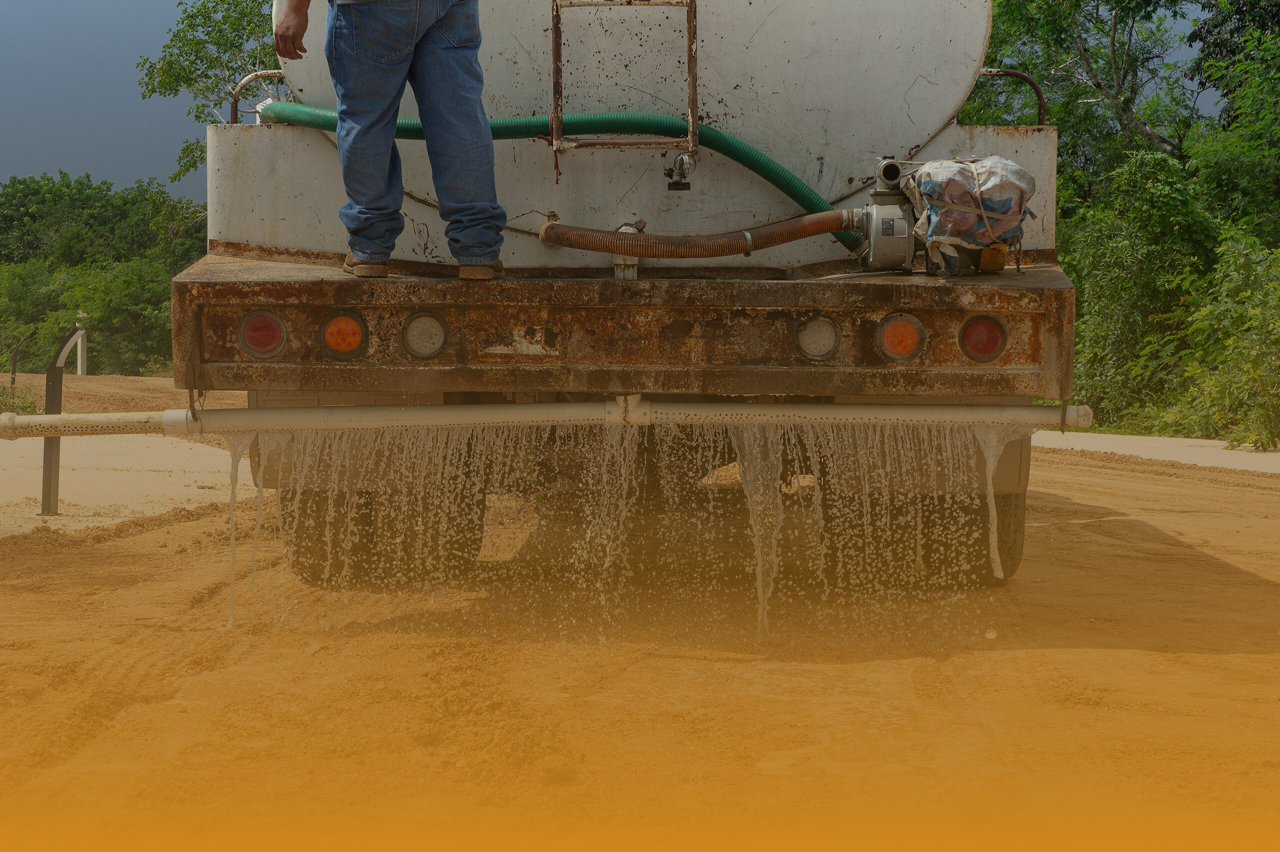
- Mixing: the stabilizer is mixed with water in a tanker.
- Application: it's sprayed evenly over the area to be treated.
- Leveling: the ground is graded to ensure proper drainage.
- Compaction: a vibratory or pneumatic roller densifies the treated soil.
- Opening to traffic: the road is ready the same day as final compaction.
Average output is 2,000 to 5,000 m² per day, which means an industrial access road or a standard-sized maneuvering yard can be completed in a week of work.
Why choose ENFIRME over other options?
ENFIRME's difference isn't just the product — it's the backing:
- More than 16 years of documented projects in Mexico, from Yucatán to Chihuahua.
- EPA, PROFEPA, CNDA, IECA, SEMARNAT, and SCT NOM N-CTR-CAR-1-04-003/14 certifications.
- On-site technical support from the lab analysis through to opening to traffic.
- Training included for construction staff in Mexico and Latin America.
- Availability nationwide: the product comes in 50–60 L drums, delivered in approximately 15 business days to any state.
In addition, unlike imported products, ENFIRME operates with local technical representation in Mexico, which guarantees support during application and follow-up after construction.

Conclusion
The ionic soil stabilizer isn't just for rural roads. It's a solution that adapts to farms, gas stations, industrial parks, mining areas, and real estate developments — any surface that needs strength, permanence, and low maintenance.
If your operation depends on a road or surface that works 365 days a year no matter the weather, ENFIRME's ionic technology is the investment that pays for itself fastest. The process starts with a lab test and a consultation.

.png)


