


.png)
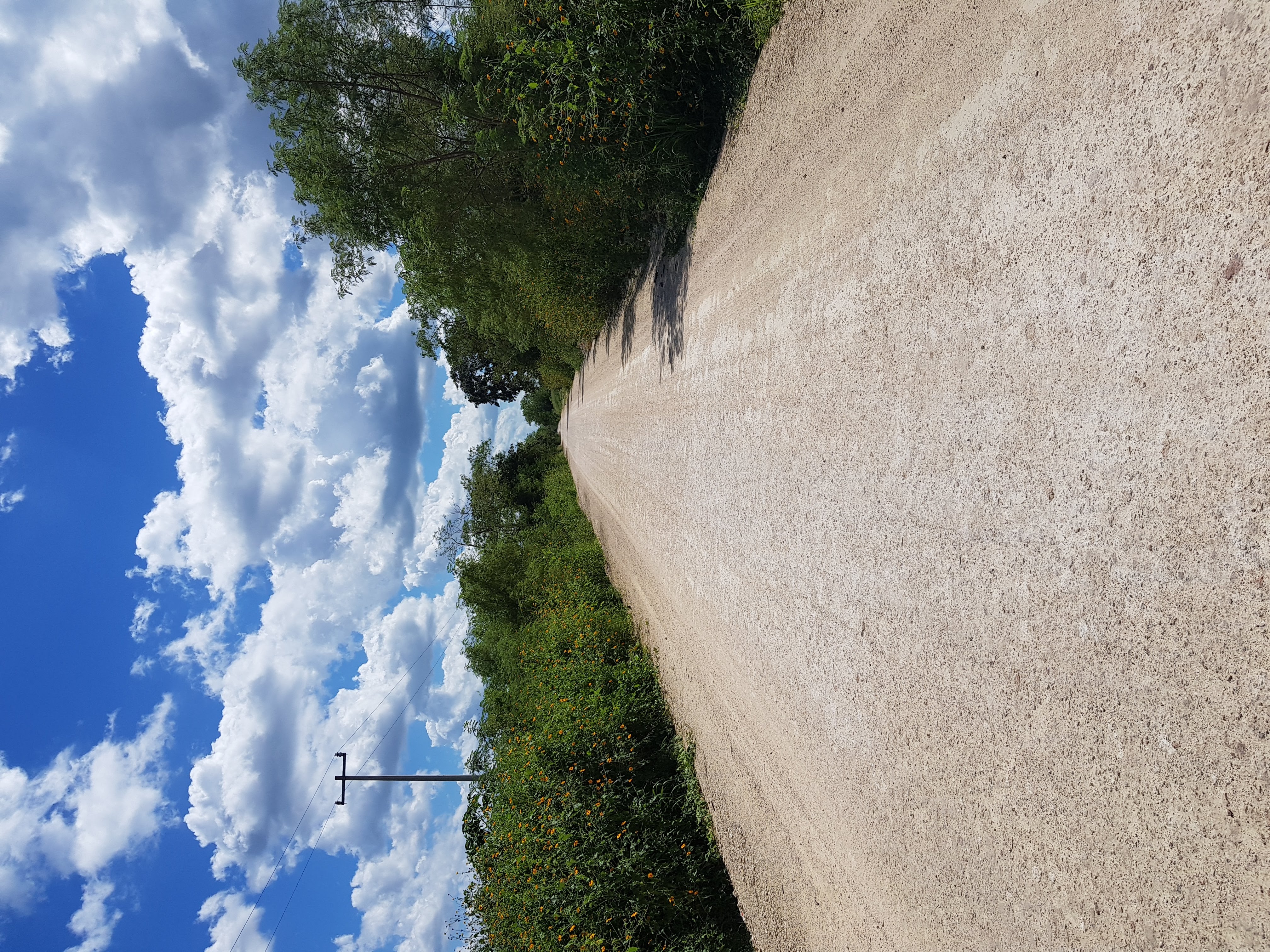
In Mexico, millions of kilometers of dirt roads connect poultry farms, industrial plants, mining areas, real estate developments, and rural communities. Many of these roads face the same cycle every year: unbearable dust in the dry season, impassable mud in the rains, potholes, and maintenance costs that repeat without ever providing a permanent solution.
Breaking that cycle requires a soil improver for roads that addresses the cause of the problem, not just its symptoms. In this article we explain what a soil improver is, what options exist in the Mexican market, how to choose the right one for your project, and why ionic technology leads as a permanent solution.

What is a soil improver for roads?
A soil improver for roads is any product, compound, or treatment that changes the physical and mechanical properties of the soil to increase its strength, reduce its sensitivity to water, and extend the service life of the road surface.
In the road and construction context, soil improvement pursues three main goals:
• Increase bearing capacity (CBR) to withstand vehicle traffic without deforming.
• Reduce plasticity so the soil doesn't turn to mud in the rain.
• Suppress dust to improve operating conditions and safety.
The key difference between a soil improver and conventional paving: it works with the material already on site, without importing aggregates or generating excavation waste. This makes it a significantly more cost-effective and faster option for road projects in Mexico.
The specific challenge of soils in Mexico
Mexico has considerable geological diversity, which makes soil improvement for construction a top-tier technical issue. Knowing the predominant soil type in your region is the starting point for choosing the right improver.
Clay soils in the southeast (Yucatán, Campeche, Tabasco, Chiapas, Veracruz)
These are the most problematic for dirt roads. Expansive clays, classified as A-7-5 and A-7-6 under the AASHTO standard, absorb large amounts of water and become completely unstable during the rainy season. In the dry season, they shrink and crack.
Silty soils in the Bajío and alluvial valleys (Guanajuato, Jalisco, Michoacán)
They have lower plasticity than clays, but erode easily and generate intense dust during the dry season. Their bearing capacity is moderate and deteriorates quickly if moisture isn't controlled.
Granular soils in the north (Sonora, Chihuahua, Coahuila, Nuevo León)
Although more stable than clays, granular soils, classified as A-4 and A-6, lose cohesion without moisture and break down under continuous heavy traffic. Scarce rainfall makes dust the main problem, with a direct impact on operations, vehicles, and staff health.
Soil improver options available in Mexico
The Mexican market offers several alternatives for road soil improvement. Each has its own advantages, limitations, and ideal application contexts.
Lime
Hydrated lime reacts with clays and reduces their plasticity; however, it requires doses of 2 to 6% by weight of the treated soil — a considerable volume of material to transport. Its typical CBR increase is 40 to 80% and needs between 3 and 7 days of curing. It doesn't offer long-term water resistance.
Portland cement
It produces rigid stabilization with high initial strength. Its dosages range from 3 to 8% by weight and mandatory curing takes 7 to 14 days. It's the most expensive option in materials and labor, with a risk of cracking from temperature changes. Its CBR increase can reach 80–150%.
Asphalt emulsions
They offer good surface waterproofing, but their effectiveness varies depending on soil type and weather conditions. They don't solve the underlying problem in unstable clay soils and can peel away in soils with high capillarity.
Ionic soil stabilizer
It's the most technologically advanced soil improver currently available in Mexico. It acts directly on the soil particles at the molecular level, producing a permanent and irreversible change in their structure. With a dosage of just 0.4 to 0.5 ml per m³, it offers the highest CBR increases on the market: up to 400% in clay soils and 100% in granular materials.
| Feature | Ionic Stabilizer | Lime | Cement | Asphalt Emulsion |
|---|---|---|---|---|
| Dosage | 0.05-0.065 L/m³ | 2-6% weight | 3-8% weight | 4-7% weight |
| CBR Increase | 100-400% | 40-80% | 80-150% | 30-60% |
| Curing time | 1-2 days | 3-7 days | 7-14 days | 2-5 days |
| Estimated service life | 3-6 years | 3-5 years | 8-12 years | 4-7 years |
| Water resistance | Excellent | Medium | Good | Very good |
| Soil types | Broad, except pure sand | Clay | Granular | Medium |
| Environmental impact | Very low | Medium | Medium-high | Very high |
| Initial cost | Low | Medium | High | Medium-high |
| ROI (payback) | 8-14 months | 18-24 months | 12-18 months | 15-20 months |
How much does it cost NOT to stabilize?
An untreated dirt road can represent between $80,000 and $150,000 MXN a year in maintenance per kilometer, plus indirect losses from wear and operational downtime. A road stabilized with ionic technology can recover that investment in 8 to 14 months and generate savings of up to 60–75% in maintenance costs over its entire service life, estimated at 6 times that of an untreated road.
Why does the ionic stabilizer lead as a soil improver in Mexico?
It works with the soil you already have
Unlike lime or cement, the ionic stabilizer doesn't require the soil to have ideal characteristics. The prior geotechnical analysis determines the exact dosage for each material.
It doesn't interrupt operations
The road can be opened to traffic the same day as final compaction. There's no 7- or 14-day wait like with cement. For industries that operate 365 days a year, this is a direct and immediate operational benefit.
A permanent change, not a temporary one
The ionic reaction irreversibly changes the polarity of the soil particles. The treated soil becomes hydrophobic: it actively resists water absorption. This eliminates the seasonal deterioration that untreated roads or those maintained with conventional methods suffer.
Backed by national and international environmental authorities
The ENFIRME ionic stabilizer holds certifications from the EPA, PROFEPA, CNDA and complies with SCT standard NOM N-CTR-CAR-1-04-003/14. This sets it apart from other products on the market that lack verifiable environmental regulatory backing. In public works projects or with companies that hold environmental responsibility standards, these certifications are decisive.
Compatibility with standard construction equipment
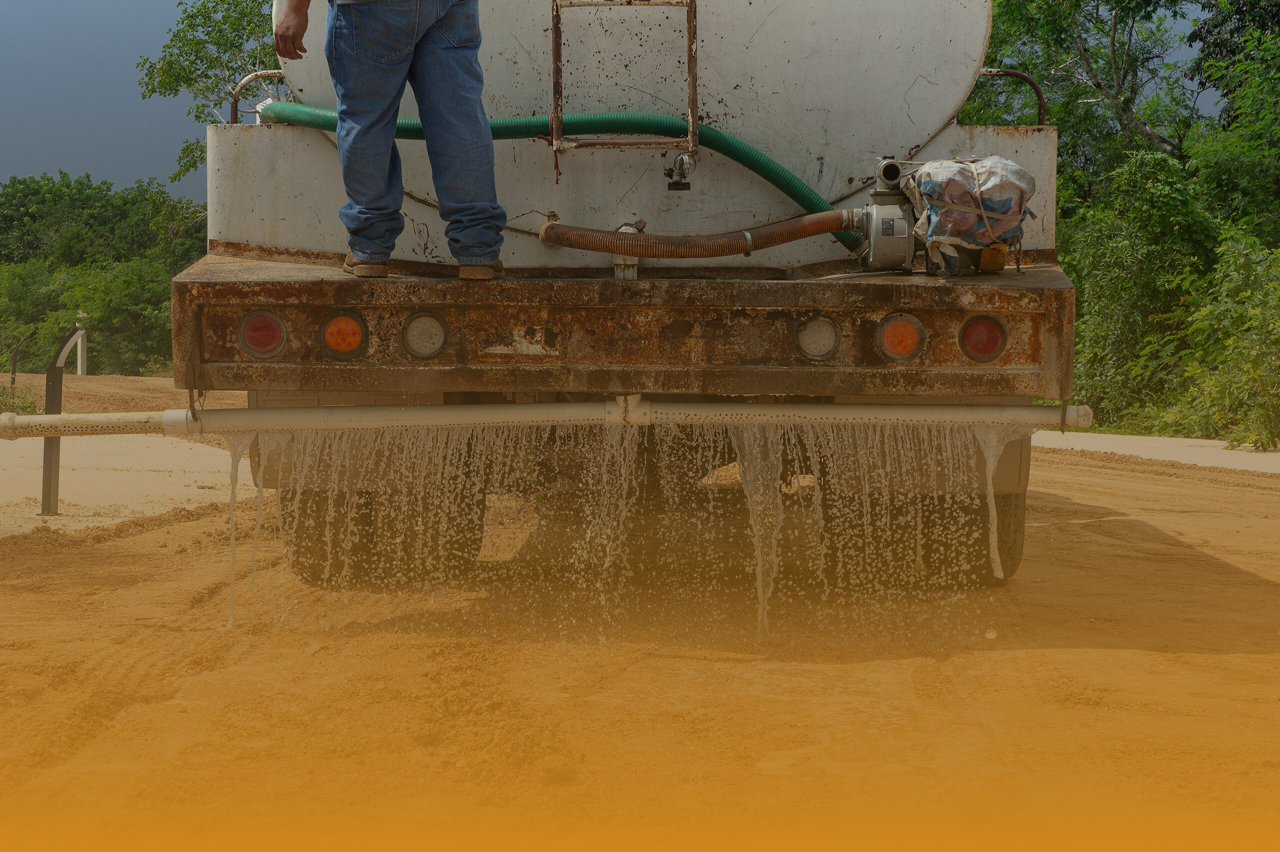
Application doesn't require special equipment. It fits into the standard process: motor grader, water tanker with pump, vibratory roller. There's no learning curve or investment in additional machinery.
How to choose the right soil improver for your project?
Choosing the right soil improver depends on four factors that should be evaluated before making any decision:
1. Soil type
Laboratory geotechnical analysis (USCS/AASHTO classification, CBR test, Atterberg limits) determines which improver works best for the material on site. High-plasticity clay soils respond exceptionally well to the ionic stabilizer, with CBR increases of up to 400%. Granular soils achieve improvements of 100%.
2. Traffic level and load type
Projects with continuous heavy traffic require an improver that guarantees sustained bearing capacity. Temporary methods aren't a viable option in these contexts.
3. Regional weather conditions
In high-rainfall areas like southeastern Mexico, water resistance is the most critical criterion. The ionic stabilizer produces a hydrophobic soil that keeps its structure even during periods of intense rainfall. In the arid areas of the north, dust suppression carries more weight in the decision.
4. Budget and expected return
The initial cost of the ionic stabilizer may seem higher compared to doing nothing, but a 5-year analysis shows savings of up to 60–75% in maintenance costs. For projects with continuous operation, it's the economically sound decision.
Grupo Enfirme: A Benchmark in Road Soil Improvement in Mexico
With more than 16 years of experience in ionic stabilization projects in Mexico, Grupo Enfirme has worked with leading companies in states such as Yucatán, Tabasco, Veracruz, Jalisco, and Chihuahua.
Every project begins with a rigorous geotechnical analysis to determine the exact dosage. The technical team supports the process from the lab through to opening to traffic, with measurable, documented results.
Sectors where Grupo Enfirme applies soil improvement:
• Poultry sector: biosecurity arches, farm access roads, and biosecurity zones.
• Oil industry: earthworks for gas stations, access roads to wells and platforms.
• Real estate developments: permanent roadways in urbanization projects.
• Industrial parks: maneuvering yards, warehouses, and internal roadways.
• Agriculture and mining: high-traffic, heavy-load roads.
Choosing the right soil improver depends on soil type, climate, traffic, and budget. The ENFIRME ionic stabilizer stands out for its technical, environmental, and economic efficiency for any road, industrial, or agricultural project in Mexico.
A well-stabilized road isn't an expense: it's an infrastructure asset that operates 365 days a year, reduces operating costs, and increases the value of the land and associated facilities.
Have questions?
Request advice from our technical team. Contact Grupo Enfirme or Message us on WhatsApp

.png)


