


.png)
Every year it's the same story. The May rains arrive, and dirt roads that worked reasonably well in the dry season become a problem: mud, potholes, cut-off access, stuck vehicles, and operational losses that pile up week after week.
The most common reaction is to wait for the season to pass before taking action. That's exactly the mistake.
What very few people know is that the rainy season isn't the worst time to stabilize a dirt road. In many cases, it's the best. The natural moisture that rain adds to the soil matches the exact technical condition the ionic stabilization process needs to deliver its best results.
In this post we explain why, how to take advantage of each stage of the season, and what makes the ENFIRME ionic stabilizer different from other methods when water is the main factor.

What happens to a dirt road when the rains arrive?
An untreated dirt road is in a constant battle with water. During the rainy season, clay soils — like those that predominate in Yucatán, Tabasco, Veracruz, Chiapas, and Campeche — absorb moisture, expand, and lose all their load-bearing capacity. The result is predictable: the soil becomes plastic, vehicles deform it, ruts and potholes form, and within a few days the road becomes impassable.
In southeastern Mexico, where the rainy season lasts between 5 and 6 months, this isn't a minor inconvenience. It's an operational disruption that can cost tens of thousands of pesos a month in maintenance, vehicle repairs, delivery delays, and lost productivity.
In the Bajío region and northern Mexico, the rains are shorter but equally destructive: silty and granular soils that seemed stable turn to mud or lose cohesion with the first heavy downpour in July.
The fact nobody tells you: why is rain an advantage for stabilization?
Here's the twist that changes the equation. The ionic stabilization process requires the soil to have a specific moisture percentage at the time of compaction — what engineers call optimum moisture content for compaction. Under normal conditions, that moisture has to be supplied with construction water: water trucks, tanks, controlled irrigation.
What does this mean in practice?
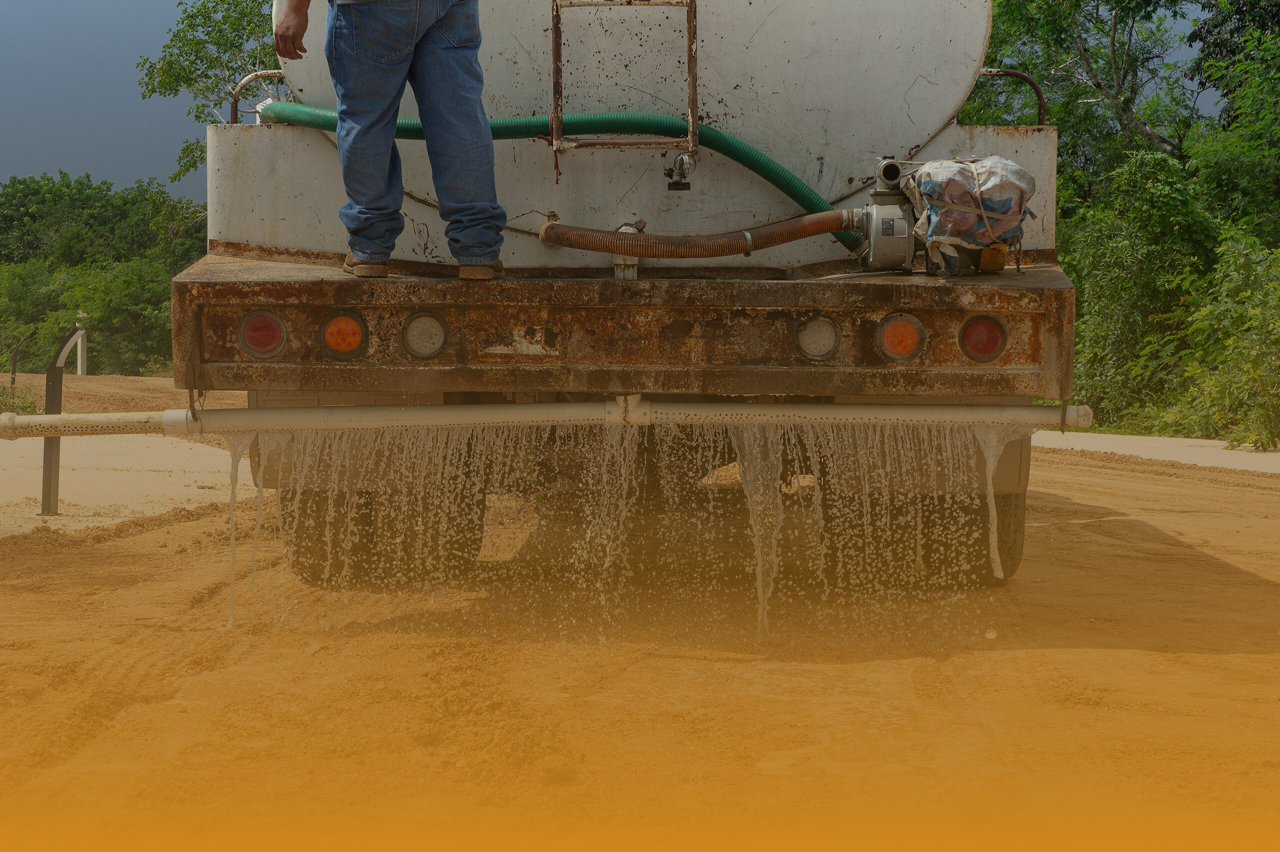
During the rainy season, the clay soils of southeastern Mexico naturally reach their optimum moisture content for compaction. This reduces construction water use by 30 to 50%, speeds up the mixing process, and improves the final density of the treated soil. In short: the rain does part of the work for you.
This doesn't apply to methods like cement or lime, which are hurt by excess moisture and need controlled conditions to cure properly. ENFIRME's ionic technology, on the other hand, works with wet soils, and its molecular reaction doesn't depend on specific weather conditions, making it the most versatile option during the rainy season.
When should you stabilize? A stage-by-stage guide
The rainy season in Mexico isn't a uniform block of time. Each stage has different conditions and calls for a different stabilization strategy. This table helps you identify the best time based on your road's actual condition:
| Timing | Road condition | Recommended action | Main advantage |
|---|---|---|---|
| Before the rains (Feb–Apr) |
Dry, passable soil | Stabilize with controlled moisture | Full control over the process and construction timeline |
| Start of the rains (May–Jun) |
Soil with natural moisture | Ideal time to stabilize | Optimum moisture available · less construction water |
| Peak season (Jul–Sep) |
Mud, potholes, impassable | Stabilize between rain events | Fast recovery · road ready in 1–2 days |
| After the rains (Oct–Nov) |
Damaged, uneven soil | Rehabilitation with ionic stabilizer | Durability for the next season |
The start of the season (May–June) is the point of greatest technical advantage. Stabilizing in this window lets you take advantage of the soil's natural moisture and have the road ready before the heaviest rains of July and August arrive.
Is your road already in trouble? Tell us about your situation via WhatsApp.
How does the ENFIRME ionic stabilizer work during the rainy season?
The ENFIRME ionic stabilizer is a liquid compound of organic origin that acts at the molecular level on the soil's clay particles. When applied, it breaks down the water film surrounding each particle, changes its polarity, and permanently binds the particles together. The resulting soil is hydrophobic: it actively resists water absorption.
This means that, once stabilized, the road isn't affected by rain. Water flows over the surface instead of infiltrating and destabilizing the base. There's no expansion, no mud formation, no loss of support under vehicle load.
In addition, the application process is compatible with standard construction equipment, and the road is ready for heavy traffic the same day as final compaction. No waiting days, no prolonged interruptions to operations.
The technical results confirm it: a CBR increase of up to 400% in clay soils, a Plasticity Index reduction of up to 30%, and an estimated service life of 3 to 6 years compared to an untreated road.
.jpg)
The rainy season isn't a reason to wait… It's a reason to act.
Dirt road stabilization with ENFIRME's ionic technology turns the season's natural moisture into a technical advantage, reduces application costs, and leaves a functional road 365 days a year, rain or shine. With more than 16 years of documented projects in Mexico, Grupo Enfirme is the reference point for ionic stabilization backed by technical, environmental, and field-proven results.
Every season that goes by without stabilizing is money spent on maintenance that doesn't solve the underlying problem.
Ready to protect your road?
Contact our technical team via our form or get direct support on WhatsApp.

.png)


